Search Results for: coffee

Coffee buzz: Java drinkers live longer, big study finds; regular and decaf are equally good – The Washington Post

I knew I wasn’t drinking it for the taste:

Coffee buzz: Java drinkers live longer, big study finds; regular and decaf are equally goodBy Associated Press, Published: May 16MILWAUKEE — One of life’s simple pleasures just got a little sweeter. After years of waffling research on coffee and health, even some fear that java might raise the risk of heart disease, a big study finds the opposite: Coffee drinkers are a little more likely to live longer. Regular or decaf doesn’t matter.The study of 400,000 people is the largest ever done on the issue, and the results should reassure any coffee lovers who think it’s a guilty pleasure that may do harm.“Our study suggests that’s really not the case,” said lead researcher Neal Freedman of the National Cancer Institute. “There may actually be a modest benefit of coffee drinking.”

via Coffee buzz: Java drinkers live longer, big study finds; regular and decaf are equally good – The Washington Post.

Now, how long until I can take it off on my taxes…


Studying alternative medicine with federal dollars – latimes.com

You. Don’t. Say.

Thanks to a $374,000 taxpayer-funded grant, we now know that inhaling lemon and lavender scents doesn’t do a lot for our ability to heal a wound. With $666,000 in federal research money, scientists examined whether distant prayer could heal AIDS. It could not.

The National Center for Complementary and Alternative Medicine, or NCCAM, also helped pay scientists to study whether squirting brewed coffee into someone’s intestines can help treat pancreatic cancer (a $406,000 grant) and whether massage makes people with advanced cancer feel better ($1.25 million). The coffee enemas did not help. The massage did.

“Some of these treatments were just distinctly made up out of people’s imaginations,” said Dr. Wallace Sampson, clinical professor emeritus of medicine at Stanford University. “We don’t take public money and invest it in projects that are just made up out of people’s imaginations.”

via Studying alternative medicine with federal dollars – latimes.com.

For those who are curious about homeopathy:


Briefs: Bullet from suicide attempt ends up in Starbucks | Northeast Tarrant | News from…

This is going to sound awful, but… if you kill yourself you’re obligated not to take others with you.  I know that people who kill themselves aren’t thinking about others, but, here’s a cautionary tale:

Bullet from suicide try ends up in Starbucks

GRAPEVINE — A Starbucks customer stirring his drink Thursday afternoon heard a bullet whiz by his ear after a man shot himself across the street from the coffee shop, police said. The man was on the front porch of his house in the 900 block of East Wall Street, said Lt. Todd Dearing, a Grapevine police spokesman. The bullet went through the man’s head and the drive-through window at Starbucks and past the customer and finally lodged in a restroom wall at the back of the business, Dearing said. The man who shot himself was taken to …a hospital…

Bold by me.

via Briefs: Bullet from suicide attempt ends up in Starbucks | Northeast Tarrant | News from….

Rifle?  Crazy high powered pistol firing a very solid bullet?  I doubt we’ll ever know, but it’s a cautionary tale.  Extremely fortunate that round didn’t collect an innocent soul.


ABEM is over-reaching their role

The American Board of Emergency Medicine (ABEM) describes itself as:

Welcome to the American Board of Emergency Medicine (ABEM) public website.  ABEM certifies qualifying physicians who specialize in Emergency Medicine and is a member board of the American Board of Medical Specialties (ABMS).  ABMS certification is sought and earned by physicians on a voluntary basis. ABEM and other ABMS member boards certify only those physicians who meet high educational, professional standing, and examination standards.  ABEM and other ABMS member boards are not membership associations.

The thing I’d like to bring your attention to is that it’s a Voluntary organization.  For a voluntary organization they’re adding lots of requirements without asking members…

Since most of you don’t know about Board Certification, it’s a way for doctors to demonstrate (mostly to their peers and employers/hospitals but also to patients) that they not only finished their residency, but paid attention and learned enough to pass the Board Certifying exam.  Yes, it’s possible to be a doctor, finish a residency, but not pass the board exam and have a nice lifelong practice anyway.

I’m Board Certified by ABEM, which required completing an accredited residency, passing first a written then an oral examination.  Okay, I’m done, right?
Emmm, no. I’m BC for 10 years.  In order to re-test to be BC for another 10 years, I have to take (and pass) yearly tests over medical literature, tests payable to the ABEM.  Which ABEM didn’t bother to figure out how to give us CME credit for.  Genius.

Imagine my surprise at ABEMs’ latest addition to hoops to jump through to maintain my Board Certification: the Assessment of Practice Performance.  In a nutshell: show ABEM that 10 patients didn’t hate my medical performance, prove that on 10 hand-picked charts I’m keeping up with published treatment benchmarks (like aspirin for ACS, antibiotics in 6 hours for pneumonia, etc), and self-certify the same to ABEM.

While that’s easily doable for me at Giant Community Hospital where I work (we already keep track of this, and a lot more), it’ll no doubt be harder for very small ED’s.  I agree this sort of performance thing needs to be tracked, and practice outliers nudged back toward the middle, but what on earth does this have to do with being Board Certified?  Where in ABEMs’ mission statement does it say they’re going to certify we’re practicing on par?  Nowhere.

This would be an entirely different argument if Board Certification were required for employment in EM (it’s not), at my hospital (it’s not), in my group (not), exempted me from any state CME requirements (doesn’t), increased my pay (doesn’t), you get the idea.  That’s a lot of work to keep a voluntary certification that gives me back… nothing tangible.  Oh, I’m a Diplomate of the American Board of Emergency Medicine, and with that and $6 I can get coffee almost anywhere.

I find it interesting there’s not much push-back on this new requirement.  ACEP’s President-Elect ‘interviewed’ ABEM President Debra Perina about this latest addition, uncritically and without any challenge: EM Leaders Discuss ABEM’s Maintenance of Certification Program.

To paraphrase the question, why? The answer:

SS: Is it correct to say that the public is asking for more accountability regarding continuing medical education, even between board examinations?

DP: That’s correct. I know that ACEP and the emergency medicine community have been following testimony in House and Senate hearings from consumer advocates requesting assurances that physicians remain competent throughout the course of their practice. The public is questioning boards that test sporadically or in some cases offer lifetime certification.

Hmm.  I genuinely understand the desire of the public to make sure docs are keeping up, and practicing inside norms (and this is not asking for a flaming: I’m aware there are docs who give amoxicillin for everything imaginable, who don’t keep up, etc) but this is a) window dressing on that front and b) if meant to serve as some reassurance to the public, it’s inadequate, at best.

But that’s really beside my point, which is that it’s not ABEM’s role to make certain my practice is up to par, that’s the role of, ultimately, my State (which licenses me) and my peers, who have a lot more impact on my practice than the ABEM.  ABEM should document that the provable (I’m keeping up with my certification, meaning the every 10 year tests, grudgingly the yearly tests*), and that’s it.

In an upcoming rant: competition is good, is it way past time ABEM had some legitimate competition from another Board Certifying organization?

*In either the first or second year of these yearly tests, the article being tested was about Neseritide, which in the article was the best thing for CHF since phlebotomy.  Of course, by the time we were being taught/tested on it, Neseritide was out of vogue as it hadn’t worked out in practice as it had in studies.  But, you had to give the currently wrong answer to the test.  Pitfalls of keeping up through testing.


It took a trainee…

…to remind me I have one of the coolest jobs in the world.

I came in to start my shift, and the department was abuzz.  Thoracotomy!  Some kind of trauma, open chest, etc.  Big mess is all I saw, and thought about the low yield and hazards.

That’s what I thought about: big futile mess.

Later, as I was getting coffee (yes, I’m back on the sauce), I asked two EMT trainees, in passing, if they’d seen anything interesting.

Their enthusiasm was palpable, and it was because they’d seen the spectacle.  They were completely energized, exited about Emergency Medicne, and will easily finish their studies solely on adrenaline.

It made me consider my first thoracotomy (fear and perspiration, mostly, with the awesomely frightening yet thrilling ‘am I actually doing ths’ moment).  Something I take for granted (and even dislike a little, as I have yet to have a positive patient outcome), but their viewpoint made me realize I’m jaded, and reminded me I have the coolest job in medicine.


You miss it when it goes

I like living on the edge of built-up civilization, but it means our little development has one electric line coming in.

Today it wanted some time off, fortunately only 4 hours. Didn’t get that cold inside, but having an all electric house has some drawbacks in that circumstance.

My wife figured out the electric-less coffee, thankfully.


MedBlogs Grand Rounds 4:44 The 200th Edition!

I’m Honored to be the first Sixth Time Host, but more importantly to be the host of the 200th Edition of MedBlogs Grand RoundsDr. Nick Genes deserves all the credit for starting (and maintaining) this wandering collection of links to the best of the MedBlogosphere (thanks, Nick!).

There were more than 40 submissions this week, and here they are in the order they were received, (with my ER Doc attention span review in parenthesis at the end of the link):

The Happy Hospitalist submits an excellent diagnostic sign of malingering, the Sleeping Husband Sign (must read for acute care docs and nurses).

Highlight Health says people lie about their fruits and vegetable intake (no!) in  Did You Eat Your Fruits and Vegetables Today? (I’d have the same reporting bias, unless coffee and beer are considered grains).

Vitum Medicinus describes how his medical school tries to convince students to become family doctors…and how they really end up
doing just the opposite in The failed mandate of our family practise course (surprise: medical students didn’t get into med school by being dumb or easily influenced).

Wait Time blogs about the upside of efficient time management: having time to spend with patients in Finding Time (this says a lot about his compassion, and makes the point that being efficient doesn’t mean heartless; it’s the opposite).

Dr. Val interviewed reporter (and Texan) Bob Schieffer about his cancer in A Survivor’s Story (Dr. Val is a good interviewer, and has some amazing access).

Amanzimtoti write about visiting Americans from an NGO (ugly Americans) in Third world aid (Bad behavior should be punished, by pointing it out).

Other Things Amanzi (yes, the last two are related) relates an arresting story from the ICU: captive (that’s some determination).

Diabetes Mine interviews an inspiring diabetes educator: The Diabetes Educator We All Should See (nice interview by one of the medblog worlds’ brightest lights).

Colorado Health Insurance Insider covers a push by ACOG and the AMA to label home births as unsafe: Shame On You ACOG and AMA (seconded here).

Dr. Tienchin Ho also has something to say about this ACOG statement in HBACM Statement on Home Births (also thinks the ACOG got it wrong; new blog is focused on good birth information, home and hospital).

Dr. Shock begins a series on the Patient-Doctor relationship with Empathy (quite good).

Insure Blog has nothing nice to say about shoddy reporting in Disturbing Carrier News (read it all to see the happy ending).

FreshMD introduces me to a new term in Tonsilloliths a.k.a. throat poo (another great term for the ED).

Suture for a Living reviews , well, Major and Lethal Complications of Liposuction (Fortunately, I don’t need it this week…).

Odysseys of George finds and cures a rare cause of upper GI bleeding: A Rare Bleeder or is it really? (with pictures!).

How to Cope with Pain wonders Are You Mindful 24/7? (something I wonder about in the ED chronic pain patients…)

In Sickness and In Health finds she can vacation in My Own Private Idaho (I like happy endings in stories).

Health Business Blog on The Medicare monster (which Will eat us alive, as no politician is going to push Means Testing until we’re past broke).

Canadian Medicine reports in the over-regulation isn’t just a US thing with It’s a wrap for dangerous donairs after health warning — and good riddance, I say (I don’t want one).

HealthLines’ Health Connects wishes Nelson Mandela a Happy 90th Birthday (do I want to be 90?  No, I want to be this age twice around…).

Unique but Not Alone write about a conversation with her daughter: But we’re not like that Mom… (I’m impressed she can write about this talk at all…).

HealthLine’s The Fitness Fixer wants to set the record straight about Three Common Swimming and SCUBA Myths in the News Again (nothing about waiting after eating before swimming…).

Covert Rationing submits Fun With Randomized Trials, and Breasts (the comma is unnecessary, as is any comment from me).

Medical Jokes alerts us to an acupuncture technique guaranteed to stop, well, any problem: Roman Acupuncture (not much repeat business).

Neuroanthropology introduces us to Bench and couch: genetics and psychiatry (I read it, and I think I understand, but I hope it’s not on the test).

Notes of an Anesthesioboist on the self-describing Why The O.R. is NOT a “Meat Market,” Grey’s Anatomy Notwithstanding; and, Looking a Patient in the Mouth: What’s That About? (good intro to one aspect of the pre-anesthesia eval, and some really interesting pictures…).

Doc Gurley on steroids for atypical infections in Body’s Too Eager… (good post, but her prestigious award under her picture got my attention).

Anatomy on the Beach has some Thoughts of a Generalist (and I think the blogger is correct).

HealthLine’s Teen Health 411 (lotta HealthLine bloggers out there) says correctly Youth Need More Exercise (though I think statins in the teens is too much).

HealthLine’s Medicine for the Outdoors (the esteemed Dr. Paul Aurebach) alerts us to MRSA Madness and Tomato Update (good info on MRSA; I disagree on wound cultures, and our food supply is laughably vulnerable.  Where are those Rajneeshees, anyway?).

The Back Pain Blog answers the age-old question Sciatica and the Epidural: Are You a Candidate? (good info for those who are considering it).

Life. Not Terribly Ordinary went to dinner, and it didn’t go well.  Awkward much? (very).

Rural Doctoring submitted several (she’s on a tear these days) but this one fit: What is Transparency? (only Flea knows for sure…).

The Cockroach Catcher advises how to get out of trouble: Try Illness First, then Children (it didn’t work; read it anyway).

Clinical Cases has found a way to use Google Trends for Research (with videos, even).

Allergy Notes has found a potential screening tool for asthma: Portable Exhaled Nitric Oxide Meter as a Screening Tool for Asthma (at 52% sensitive and $4200 it’s going to be a tough sell).

Dr. Penna has an intro to Molecular Orthopaedics – What is it (orthopedists are getting smarter…).

HealthLine’s Tech Medicine has a  Review of Epocrates on the iPhone (does anyone own Palm stock anymore?  If so, why?).

HealthLine’s Fruit of the Womb has a comment string highlighting that Amniocentesis is Not Without Risk (good and bad outcomes within).

and Last but not Least,

Emergiblog thinks MedBloggers should have their own conferences, and outlines her thoughts  in A League of Our Own? (I’m in).

If you’ve read this far either I accidentally missed your submission (sorry, attach it in the comments) or you’re in desperate need of an actual life.

Or, you’re reading to see this: Next Weeks’ edition will be found at Edwin Leaps’.

Thanks for coming!

Update: Kim from Emergiblog has found an illustration of my grand round skills:

funny pictures

Heh.  Thanks, Kim!


Farming community moving on after arsenic poisoning – Boston.com

I blogged about this when it happened in 2003 (and the suicide of a man who posthumously took the blame), and wondered idly if anything more came of it. Here’s the answer (complete with a what happened in a small ED that night description).

Farming community moving on after arsenic poisoning

By David Sharp, Associated Press Writer | April 26, 2008

NEW SWEDEN, Maine –It has been five years since this tiny farming community was turned upside down by a crime that still baffles: Someone used arsenic to spike the coffee at Gustaf Adolph Lutheran Church, killing one parishioner and making 15 others violently ill.

Soon those who drank the coffee were throwing up, suffering diarrhea, or both.

The first patient arrived in the Cary Medical Center emergency room in nearby Caribou at 3:30 p.m., and sick parishioners kept pouring in over the next six hours. Dr. Dan Harrigan, an emergency room physician, arrived at work at 6:30 p.m. to find one of the parishioners outside on his knees.

Not knowing what they were dealing with, doctors and nurses at the 65-bed hospital struggled to keep patients’ blood pressure from dropping too low.

It wasn’t a pretty sight. Nurses described countertops and the floors covered with vomit-filled basins, buckets and garbage cans. "Out of 26 years in emergency medicine, I doubt I’ll have another night like that," Harrigan said.

By dawn, one of the parishioners had died, several had been transferred to Eastern Maine Medical Center in Bangor, and doctors had figured out they were dealing with a heavy metal poisoning. Laboratory tests later confirmed it was arsenic.

Read the article: several were left with lifelong disabilities, but their community moves on.


I got a present today

At work this evening there was a nice assortment of different coffees on the docs’ table, with this attached to the top:

care-package-for-me.jpg
I appreciate it (and thanks, Nurse 1961). I’ll try them out.

Still just one cup a day though.


Fair Warning

I’m swearing off coffee at work.

You’ve been warned.

Update, from the comments: ‘Women and Children to be most affected’.  Heh.


Emergency Physicians Monthly is blogging ACEP’s Scientific Assembly

Here’s their first blog entry from ACEP:

ACEP Blog: From the floor
Monday, 08 October 2007

Nothing says ACEP Scientific Assembly like a line of 50 docs waiting for a mug a free coffee. That’s right, it’s Monday morning, the first day of the ACEP convention, and activities got started early. ..

Opening lectures began at 7:30, if you can believe it. I hope the speaker was from the East Coast and still jet-lagged. The minute the docs start surging into the exhibit hall, the stories start flying. Here are just a few highlights from the morning:

I wish I’d thought of that.  It would have given me a reason to actually attend (besides all the wonderful talks).

And this from Logan Plaster at EP Monthly:

If [your / our] readers have any questions about the convention, we aim to seek out answers and post them in real time.

There’s a ‘contact’ form at the blog link, so ask questions for them there, not here.


How to make coffee 102

Coffee 101: put coffee in filter, add water to reservoir, and turn on the heat. You’ve got that, this is 102.

This is very-modestly advanced coffee making, but the payoffs are:

  • better tasting coffee (I don’t know why)
  • no coffee grounds in the pot
  • much easier to clean the basket after brewing
  • elevation in the coffee making ranks

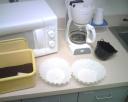
Begin with standard hospital coffee reagents: low-bid coffee, two filters, and a budget drip coffeemaker:
Coffee making reagents needed

Add your normal amount of coffee to filter 1:

Coffee added to filter 1

Gather the edges of filter 1, to enclose all the coffee in one filter:

Coffee filter 1 gathered for next step

Place filter one gathered-edge down into filter 2:

Filter 1 in 2

Add filters 1 & 2 to the basket, and make your coffee.

Both filters in basket, ready to brew

Be prepared to do it over and over when people tell you your coffee is good!


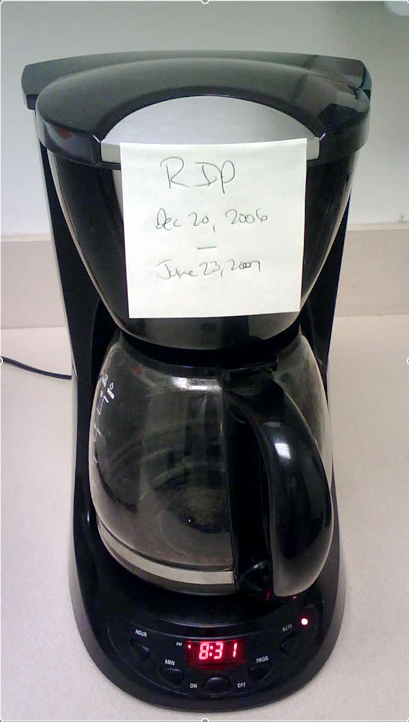
Coffee Maker update

Today it died. The coffee maker I bought December 20th, 2006. The heating element expired.

It gave good service, and ran 24/7 for seven months, which is a lot longer than I thought it would.

Tomorrow, a new one.


BBC NEWS | Health | Coffee ‘could prevent eye tremor’

BBC NEWS | Health | Coffee ‘could prevent eye tremor’

Coffee ‘could prevent eye tremor’

People who drank coffee had a lower risk of blepharospasm
Drinking coffee protects against an eyelid spasm that can lead to blindness, a study suggests.Italian researchers looked at the coffee drinking and smoking habits of 166 people with blepharospasm.

Sufferers have uncontrollable twitching of the eyelid which, in extreme cases, stops them being able to see.

One or two cups of coffee a day seemed to reduce the risk of the condition, the team reported in the Journal of Neurology, Neurosurgery and Psychiatry.

Again, coffee saves.  What can’t it do?


How my day went, per the coffee maker

(My enjoyment of coffee is well documented here, so no need to retrace steps).

We were pretty busy for the first hour, so then I went to get my first cup. Coffee maker is empty. Big mess around same. Cleaned up the mess, started coffee.

Get crushed with sick patients, work like crazy to keep the ill and injured as well as possible.

2 hours later, a break; coffee maker is empty. Start another pot.

An hour and a half later, some re-evals are done, and there’s two minutes of slack time, and time for coffee. 1/2 pot available, but no cups.

Aargh.

Another hour later, finally there’s a break, and a cup, and coffee! Huzzah!

Home two hours later. One cup.

Crazy shift!