Let’s say, hypothetically, you could design the ED of the Future. I say hypothetically as there may be a new (like New) ED in my future. Maybe; it sounds like a heck of a challenge. Considering we’re a Trauma Center and currently see nearly 100K/year in volume, and have an admission rate that’s between 18-35%,
What would that new ED look like, from the following viewpoints :
the patient
the triage nurse (is there one?)
the treating nurse
the ED doc
the consultant
the hospital admissions team (billing)
the OR
the Tele units
the Floor units
ED discharge areas
physical plant
I have a few ideas, but am frankly hamstrung by a lack of ‘out there’ imagination. Let’s hope you’re not similarly limited. Don’t feel like you need to answer all of these, but I’m interested in your ‘out of the box’ ideas…which you’ll get full (if ephemeral) credit for.
The irony here is that Eli Lilly has advanced sepsis care (as a prelude to using their drug), and while Xigris hasn’t panned out, aggressive sepsis resuscitation has.
Eli Lilly is withdrawing drotrecogin alfa (Xigris) from all markets worldwide after a major study failed to show a survival benefit for patients taking the drug.
…
Xigris should be discontinued immediately in patients currently receiving it and should not be started in new patients, the company said.
The trial with the bad news on Xigris was called PROWESS-SHOCK, a placebo-controlled study with 28-day mortality as the primary outcome and planned enrollment of nearly 1,700 patients.
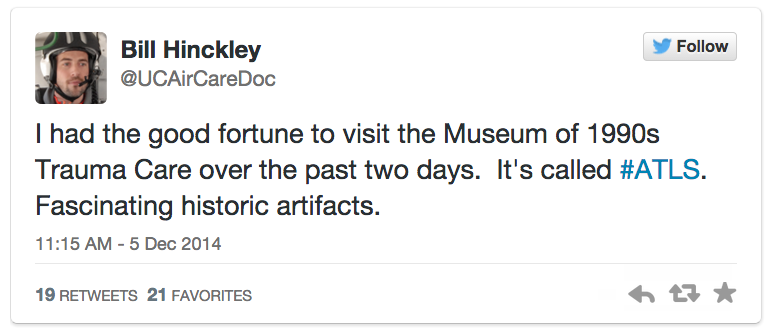
If you don’t follow me on twitter, you missed my play by play of the recent ACEP 2011 Scientific Assembly from San Francisco. Several of us attending twittered (and it was terrifically entertaining to meet them and socialize)!
It’s in San Francisco this year, and starts in the morning. While I’m NOT a morning person I’m going to make as much of it as I can, as the lectures are good, and worth the time.
I plan to live-tweet my conferences tomorrow, so if you’re interested follow along on Twitter @gruntdoc. Last year I had more than 200, and some people liked them. We shall see, some lectures, and lecturers, are more quotable than others.
Gastroenterologist Michael Kirsch put up a post on his blog that was then reposted over at ACP Hospitalist asking where the threshold for admitting a patient to the hospital should be.
He asserts that there should be more collaboration between medical colleagues to determine whether or not a patient needs to be hospitalized…
Kudos to MedStar (our Fort Worth EMS provider) for their excellent work on this project:
The Community Health Program was started in 2008 after MedStar officials discovered that 21 patients were using a big chunk of ambulance and emergency department resources. Those patients triggered more than 800 ambulance calls and cost the system more than $962,000 in charges, most of which were never collected because the patients lacked health insurance.
Nine of the 21 were selected for the program. They experienced a 77 percent reduction in their need for services during a 30-day test.
Okay, it’s kind of amusing, and I hope it induces someone to learn compression only CPR. Which is WAY easier to do, and teach, than what I started with back in the day (15 compressions, 2 breaths, rinse/repeat).
But if this makes Disco come back, is it worth it?
Read the rest, and wonder. Others practice risk-avoidance to the ED, and then we wonder why our patients are unhappy and give us poor scores.
Man and squirrel fight it out in man’s driveway. Squirrel scratches him twice, man runs inside grabs BB gun and plugs squirrel ala Elmer J Fudd. Man then calls health department for advice about what to do. Health department tells him to go to ED for rabies shots.
…Actually, statements like that do serve one purpose. They make it a pretty good bet that none of the doctors in our department will ever refer another patient to you or your your hospital…
Laugh if you want, this helps my life, at least at work.
For months after starting my current gig, I would sometimes get to work with everything in all my pockets, and sometimes not.
I’d forget my ID, or my pen, or my phone, or my…well, there you go.
Then my OCD started to kick in, and, a Mental Checklist was born.
I now have to get 6 things, and set them on the table or I screw it up every time.
ID
stethoscope
my phone
work phone
pen
sharp stick (I’ve written about this before, but cannot find it. You should search an ER blog for the word ‘knife’ and then wonder why you bothered).
Last week I apparently went against the checklist, and halfway through the shift realized I’d lost my ID. Of course, after about a combined half-hour of fruitless search I gave up, and found it in my bag on the way out. Geez.
Yeah, it sounds stupid. But if it’s stupid and it works, it’s not stupid.
When emergency physician Harvey Castro asked a nurse to start a dopamine dose for a hypotensive patient one day, he watched the nurse leave the room, find the book that could guide her to the titratable dose, look in the index and then flip through until she found what she needed. Castro wondered, Isn’t there a more efficient way?
A fellow DFW doc who’s done well in the Medical App world ( Deep Pocket Series ).
Dr. Castro was nice enough to let me play with some of his apps about a year ago, and while I never found a big use for them (my practice style, no knock on him) they were well done and approachable for me.